Step one · about 3 minutes
What you do in a game of Dominions 6
You are a would-be god with a nation to run. Each turn you give orders, then every player's orders resolve at once.
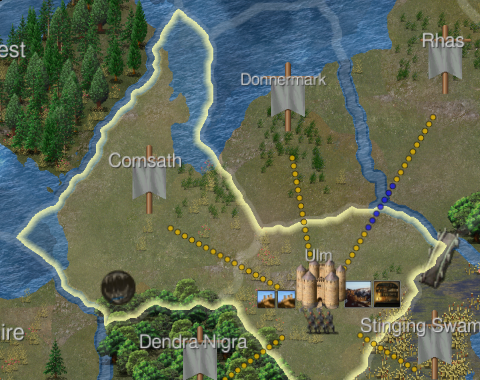
You play a pretenderpretender · The god you design before the first turn from a limited budget of points, covering its body, magic paths, dominion, scales and how soon it arrives. Full article : a would-be god who means to be the only one. You do not fight or build anything yourself. You have a nationnation · The people your god leads: their troops, commanders, mages, sacred units, magic paths and history. Each nation is a different game. Full article to do that for you, with its armies, magesmage · A commander with skill in one or more magic paths. Mages research, cast spells, forge items and search provinces for magic sites. Full article and priestspriest · A commander who preaches to spread your dominion, blesses sacred troops on the battlefield and can call a dead pretender back. Full article , and a map of provincesprovince · One region of the map. It holds people, income, resources and your troops, and provinces are what players take from each other. Full article held by the independentsindependents · The neutral peoples who hold provinces nobody owns. You conquer them to expand, and a game setting decides how strong they are. Full article and by other pretenders who want the same thing you do.
A turn
A game is a series of turnsturn · One month of game time. Every player gives orders, then all orders are carried out together. Full article , and one turn is one month of game time. In each one you look over your provinces, spend gold on troops and commanderscommander · A unit that leads troops or does a job such as research, forging or preaching. Only commanders carry gems and change equipment. Full article , send armies into neighbouring provinces, set your mages to researchresearch · Points your mages produce each month towards the next level in a school of magic. Higher levels unlock stronger spells. Full article or to forgeforging · A mage's order that makes a magic item, paid for with gems. What a mage can forge depends on research. Full article , and have your priests preach. Then you end the turn. Nothing happens until every player has done the same: all the orders are carried out together, battles included, and the next turn opens with a list of messages about what went well and what did not.
Dominion
Your god’s influence on the world is its dominiondominion · The spread of your god's faith. It is not the same as who owns the land, and it matters in battle, in unrest and in how strong your god and its sacred troops are. Full article . It spreads from your pretender, your capital, your templestemple · A building that spreads your dominion and lets your priests preach and bless in that province. Full article and a prophet if you name one, and a province under your dominion slowly takes on the preferences you gave your god, the scalesscales · The dials chosen with your pretender, such as order against turmoil or luck against misfortune. They shape the whole empire slowly but permanently. Full article , such as order or turmoil and heat or cold. If your god has no dominion left anywhere on the map, you are out of the game. Step two explains how to design a god, and the dominion of a god is one of the things you buy.
How you win
The usual way to win is to hold enough Thrones of AscensionThrone of Ascension · A special province worth 1, 2 or 3 ascension points. Holding enough of them wins the game under the default victory rule. Full article , special provinces scattered across the map; the game settingsgame settings · The options chosen when a game is created: the makeup of the world, the divine rules, and the victory conditions on the Thrones tab. Full article say how many ascension pointsascension points · The score Thrones of Ascension give their holder. The game settings say how many a player must hold to win. Full article are needed. A game can instead be set up so that the last pretender standing wins, which the settings call Conquer allConquer all · A victory setting where the game is won only by eliminating every other player, instead of by holding Thrones of Ascension. Full article . Step five covers both.
The order the game asks you things
Before turn one you meet a short run of screens. The manual lists them in this order, and the steps of this guide take them in the order that is easiest to understand, not the order of the screens.
- The map. Pick a ready-made map or have one made, and choose its size. Step five has the choices.
- The ageage · Early, Middle or Late. The age you pick decides which nations can be played. In general, Early Age nations have stronger mages and weaker troops. Full article . Early, Middle or Late, which decides which nations you can play. Step four explains them.
- The players. Your nation, and the computer opponents with theirs. Step four again, and step five for the opponents.
- Your pretender. The design screen. Step two.
- The game settingsgame settings · The options chosen when a game is created: the makeup of the world, the divine rules, and the victory conditions on the Thrones tab. Full article . The rules of this particular world, and the throne and Cataclysm choices on the Thrones tab. Step five.
Then the first turn opens. The same step five walks through it, and step three explains the battles you will not be steering.
Words you will meet
None of this needs to make sense yet. Every game term in these steps is a glossary term: hover it, or press it on a phone, to read a short definition, with a link to the page that explains it in full. The list at the end of each step gathers the terms used on that page. When you want the rules under a term, the mechanics pages and the glossary are where they live, and the longer strategy article shows how the choices stack up.
The next five steps take one piece at a time: your god, battles, your nation, a first game, and what to do when you are lost.
Terms on this page
Generated from the terms used above. This block is what prints.
- pretender
- The god you design before the first turn from a limited budget of points, covering its body, magic paths, dominion, scales and how soon it arrives. · Full article · back to text
- nation
- The people your god leads: their troops, commanders, mages, sacred units, magic paths and history. Each nation is a different game. · Full article · back to text
- mage
- A commander with skill in one or more magic paths. Mages research, cast spells, forge items and search provinces for magic sites. · Full article · back to text
- priest
- A commander who preaches to spread your dominion, blesses sacred troops on the battlefield and can call a dead pretender back. · Full article · back to text
- province
- One region of the map. It holds people, income, resources and your troops, and provinces are what players take from each other. · Full article · back to text
- independents
- The neutral peoples who hold provinces nobody owns. You conquer them to expand, and a game setting decides how strong they are. · Full article · back to text
- turn
- One month of game time. Every player gives orders, then all orders are carried out together. · Full article · back to text
- commander
- A unit that leads troops or does a job such as research, forging or preaching. Only commanders carry gems and change equipment. · Full article · back to text
- research
- Points your mages produce each month towards the next level in a school of magic. Higher levels unlock stronger spells. · Full article · back to text
- forging
- A mage's order that makes a magic item, paid for with gems. What a mage can forge depends on research. · Full article · back to text
- dominion
- The spread of your god's faith. It is not the same as who owns the land, and it matters in battle, in unrest and in how strong your god and its sacred troops are. · Full article · back to text
- temple
- A building that spreads your dominion and lets your priests preach and bless in that province. · Full article · back to text
- scales
- The dials chosen with your pretender, such as order against turmoil or luck against misfortune. They shape the whole empire slowly but permanently. · Full article · back to text
- Throne of Ascension
- A special province worth 1, 2 or 3 ascension points. Holding enough of them wins the game under the default victory rule. · Full article · back to text
- game settings
- The options chosen when a game is created: the makeup of the world, the divine rules, and the victory conditions on the Thrones tab. · Full article · back to text
- ascension points
- The score Thrones of Ascension give their holder. The game settings say how many a player must hold to win. · Full article · back to text
- Conquer all
- A victory setting where the game is won only by eliminating every other player, instead of by holding Thrones of Ascension. · Full article · back to text
- age
- Early, Middle or Late. The age you pick decides which nations can be played. In general, Early Age nations have stronger mages and weaker troops. · Full article · back to text
Not sure this is your kind of game? That's a reasonable conclusion — here is what it is and isn't.