Step four · about 4 minutes
Pick your first nation
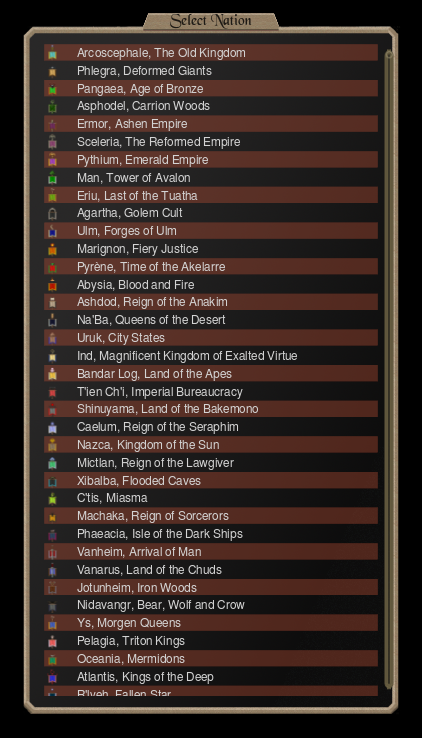
A nation is what your god inherits. You need one to start, and a few are easier to learn on than the rest.
A nationnation · The people your god leads: their troops, commanders, mages, sacred units, magic paths and history. Each nation is a different game. Full article is what your god inherits: its troops and commanders, its magesmage · A commander with skill in one or more magic paths. Mages research, cast spells, forge items and search provinces for magic sites. Full article and the pathsmagic path · One kind of magic: Fire, Air, Water, Earth, Astral, Death, Nature, Glamour or Blood, plus Holy for priests. Skill in a path decides the spells a caster can use. Full article of magic they can reach, its sacredsacred · Sacred troops are a special class that needs holy points to recruit. They receive your god's blessing when they fight in a province where your dominion is strong. Full article units, and a history, which the game shows you before you design your god. Nations cannot be duplicated: a game has one of each, and the computer opponents take theirs from the same list.
The three ages
Every nation belongs to one of three agesage · Early, Middle or Late. The age you pick decides which nations can be played. In general, Early Age nations have stronger mages and weaker troops. Full article , and the age you pick at the start decides which nations you can play. In general, Early Age nations have stronger mages and weaker troops, and by the Late Age steel is everywhere. The wiki has a page for each age, Early, Middle and Late, and the nations overview lists every nation with its magic paths. The same people can look quite different in different ages.
What to look at on a nation page
A nation’s page, such as Ulm, shows what the Inspector’s data lists for it. Four things are worth checking before you choose:
- Its magic paths. These are the paths its mages can reach, which are also the paths your pretender will probably want. Step two explains how paths are bought.
- Its sacred units. A nation with strong sacredsacred · Sacred troops are a special class that needs holy points to recruit. They receive your god's blessing when they fight in a province where your dominion is strong. Full article troops gets a lot from a blessing, and the pretender design is where you buy it.
- Its scales. Some nations prefer a particular heat or cold and do worse away from it, so the scales screen opens at the setting that nation likes.
- Where it recruits. A nation’s own units are hired only where it has a fortfort · A building that protects a province, collects resources and opens the nation's special recruits there. Your capital starts with one. Full article . The first game starts with one, in the capital, and each fort you add makes the same list available in another province.
A few nations do not recruit all of their army, because part of it arrives some other way. The wiki’s page on nations that get units without recruiting says what is known so far and what is not. Until that is settled they are a poor way to learn what recruiting means.
Four to start with
The cards below are a starting point, not a ranking. Each one is here because it keeps one part of the game simple while you learn the rest. Pick any nation that appeals to you, though: for a first game the main thing is that you enjoy reading its units.
There are over a hundred across the three ages. You need one. These four are a starting point, each for a different reason: pick whichever sentence sounds like you.
Middle Age
Start here
Ulm
If you want to learn the map before the magic.
Ulm's strength is steel. It fields heavily armoured infantry, crossbowmen and knights, and its smiths are its mages, working mostly Earth magic with some Fire. With so little magic to choose from, the first game can be about movement, money and battles. When a battle goes wrong, it is usually easy to see why.
Main magic pathsE2F1
Early Age
Arcoscephale
If you want to try magic without drowning in it.
The Golden Era of Arcoscephale fields Greek-style soldiers, from slingers to chariots, and mages who are strongest in Nature and Air. That is enough magic to learn what research and spellcasting are for, without every path at once.
Main magic pathsN3A2
Middle Age
Man
If you like archers and a plan.
Man, the Tower of Avalon, has longbowmen, longspears and orders of knights, and witches whose magic is Nature first, then Glamour. It rewards placing troops well and scripting them carefully, which is most of what battles are about. Less forgiving than Ulm, and more instructive.
Main magic pathsN3G2
Middle Age
Caelum
If you want one kind of magic, done well.
In Caelum's Reign of the Seraphim, seraphs lead militia, storm guards, iceclads and mammoth riders. Its mages work Air magic first and Water second, so your first research choices stay few while you learn what magic can do in a battle.
Main magic pathsA3W2
Terms on this page
Generated from the terms used above. This block is what prints.
- nation
- The people your god leads: their troops, commanders, mages, sacred units, magic paths and history. Each nation is a different game. · Full article · back to text
- mage
- A commander with skill in one or more magic paths. Mages research, cast spells, forge items and search provinces for magic sites. · Full article · back to text
- magic path
- One kind of magic: Fire, Air, Water, Earth, Astral, Death, Nature, Glamour or Blood, plus Holy for priests. Skill in a path decides the spells a caster can use. · Full article · back to text
- sacred
- Sacred troops are a special class that needs holy points to recruit. They receive your god's blessing when they fight in a province where your dominion is strong. · Full article · back to text
- age
- Early, Middle or Late. The age you pick decides which nations can be played. In general, Early Age nations have stronger mages and weaker troops. · Full article · back to text
- fort
- A building that protects a province, collects resources and opens the nation's special recruits there. Your capital starts with one. · Full article · back to text
Not sure this is your kind of game? That's a reasonable conclusion — here is what it is and isn't.