Step three · about 4 minutes
How a battle resolves without you
You never click on a soldier during a fight. You set up your army and its orders before the battle, then watch the replay.
This is the part that surprises people. When two armies meet, you are not there. Battles are fought while the turnturn · One month of game time. Every player gives orders, then all orders are carried out together. Full article is being resolved, with every soldier, magemage · A commander with skill in one or more magic paths. Mages research, cast spells, forge items and search provinces for magic sites. Full article and priestpriest · A commander who preaches to spread your dominion, blesses sacred troops on the battlefield and can call a dead pretender back. Full article acting on its own equipment and abilities, and you see the result afterwards: a message says there was a battle, and “View battle” plays it back.
What you set before a fight
What you control happens before the fight. A squadsquad · A group of units led by a commander. You place squads on the battle map before a fight. Full article is a group of units led by a commandercommander · A unit that leads troops or does a job such as research, forging or preaching. Only commanders carry gems and change equipment. Full article , and you place your squads on a small battle map. Then you give each commander battle ordersbattle orders · The script you give a commander before a fight: up to five single-round orders, then a main order for the rest of the battle. Full article : hold back, attack, fire on a target, cast a particular spell. A commander can have up to five specific orders scripted, one for each of the first rounds of the fight, and a main order that guides it for the rest. A commander you give no orders is run by the game.
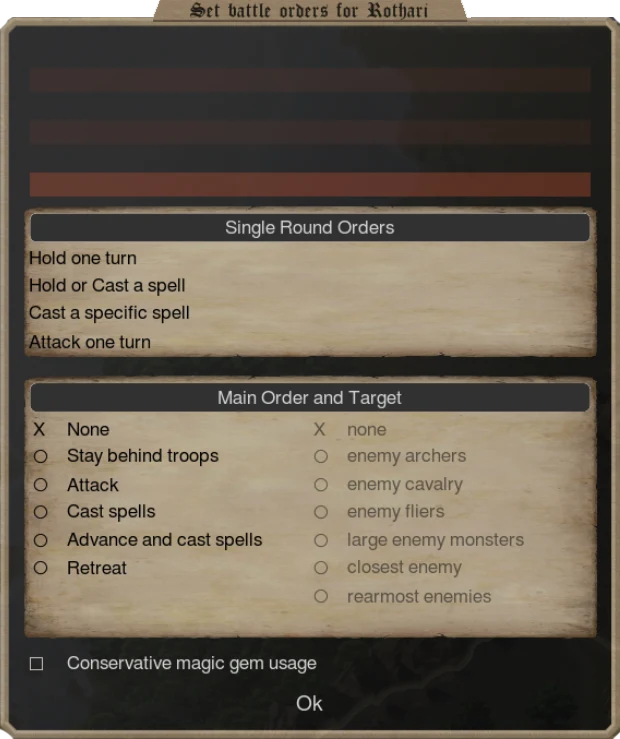
The main orders on that screen are: stay behind troops, attack, cast spells, advance and cast spells, and retreat. Each can be given a target: the closest enemy, enemy archers, cavalry or fliers, large monsters, or the enemy at the rear. The tick box at the bottom, conservative magic gem usage, tells a mage to spend gemsgems · The currency of the stronger magic, produced by magic sites. Rituals, forging and some battle spells spend them. Full article carefully, which matters once your mages carry them. The orders of your magesmage · A commander with skill in one or more magic paths. Mages research, cast spells, forge items and search provinces for magic sites. Full article and priests are the ones to think about first, because what they cast is the part of a fight that you chose.
So a battle is a bet you placed last turn, and the replay tells you whether the bet was a good one. Losing an army because a mage was scripted to cast the wrong spell is normal, and more instructive than it feels at the time.
What to read in the replay
The replay shows both armies fighting, and you can pause it and step through. Four numbers explain most of what you see:
- Hit pointshit points · How much damage a unit can take before it dies. Damage that gets past its protection comes off hit points, and a unit at zero is dead. Big creatures usually have many more than ordinary soldiers. Full article say how much damage a unit takes before it dies.
- Protectionprotection · What stands between a unit and a blow, from its armour plus any natural protection of its own. The defender adds a DRN to it, and a hit wounds only when the damage total is higher, so a tie does nothing. Full article says how much of a blow its armour stops. Combat explains how a blow is settled.
- Moralemorale · A unit's nerve. Fear, losses and a fallen commander test it, and a unit that fails can break and flee. Higher morale holds the line longer; blessings, items and good leaders can raise it. Full article says how well a unit holds when things go badly. For a morale check the game compares the unit’s morale with 12 plus a random roll, so a unit with morale 10 passes three times in ten.
- Fatiguefatigue · Strain that builds up in a unit. Casting tires mages, heavy armour tires the wearer, and a tired unit takes armor-defeating hits much more often. Full article builds up as a unit fights and casts, and it makes the unit worse at both.
Units also have an attack skillattack skill · How well a unit lands blows. The attacker adds a DRN to its attack skill and the target adds one to its defence skill; the blow lands only if the attacker's total is higher. Full article and a defence skilldefence skill · How hard a unit is to hit. The defender adds a DRN to its defence skill, and a blow that does not beat that total misses, so a tie goes to the defender. Shields and some abilities add to it. Full article , and these decide whether a blow lands at all.
The dice underneath
Underneath, every attack is a small dice roll. The attacker’s attack skill is compared with the defender’s defence skill, and each side adds a DRNDominions Random Number · Two open-ended dice added together. Most contests in the game add one to each side's value before comparing the totals. Written drn, in lower case, when only one die is used. Full article , a Dominions Random Number: two six-sided dice, where any die that shows a 6 counts as 5 and is rolled again and added. The attack has to beat the defence; a tie misses.
Because a die can keep rolling, nothing in this game is ever quite safe.
You do not need any of the arithmetic to play. When you want it, the rules are on DRN: the dice behind most rolls and Combat, and the units tables list the numbers of every soldier you might meet.
Next, step four is about the nation whose soldiers these are.
Terms on this page
Generated from the terms used above. This block is what prints.
- turn
- One month of game time. Every player gives orders, then all orders are carried out together. · Full article · back to text
- mage
- A commander with skill in one or more magic paths. Mages research, cast spells, forge items and search provinces for magic sites. · Full article · back to text
- priest
- A commander who preaches to spread your dominion, blesses sacred troops on the battlefield and can call a dead pretender back. · Full article · back to text
- squad
- A group of units led by a commander. You place squads on the battle map before a fight. · Full article · back to text
- commander
- A unit that leads troops or does a job such as research, forging or preaching. Only commanders carry gems and change equipment. · Full article · back to text
- battle orders
- The script you give a commander before a fight: up to five single-round orders, then a main order for the rest of the battle. · Full article · back to text
- gems
- The currency of the stronger magic, produced by magic sites. Rituals, forging and some battle spells spend them. · Full article · back to text
- hit points
- How much damage a unit can take before it dies. Damage that gets past its protection comes off hit points, and a unit at zero is dead. Big creatures usually have many more than ordinary soldiers. · Full article · back to text
- protection
- What stands between a unit and a blow, from its armour plus any natural protection of its own. The defender adds a DRN to it, and a hit wounds only when the damage total is higher, so a tie does nothing. · Full article · back to text
- morale
- A unit's nerve. Fear, losses and a fallen commander test it, and a unit that fails can break and flee. Higher morale holds the line longer; blessings, items and good leaders can raise it. · Full article · back to text
- fatigue
- Strain that builds up in a unit. Casting tires mages, heavy armour tires the wearer, and a tired unit takes armor-defeating hits much more often. · Full article · back to text
- attack skill
- How well a unit lands blows. The attacker adds a DRN to its attack skill and the target adds one to its defence skill; the blow lands only if the attacker's total is higher. · Full article · back to text
- defence skill
- How hard a unit is to hit. The defender adds a DRN to its defence skill, and a blow that does not beat that total misses, so a tie goes to the defender. Shields and some abilities add to it. · Full article · back to text
- DRN
- Two open-ended dice added together. Most contests in the game add one to each side's value before comparing the totals. Written drn, in lower case, when only one die is used. · Full article · back to text
Not sure this is your kind of game? That's a reasonable conclusion — here is what it is and isn't.