Step two · about 11 minutes
Designing your pretender god
Before the first turn you build your god from a budget of points, spent on a body, magic, dominion, scales and how soon it wakes.
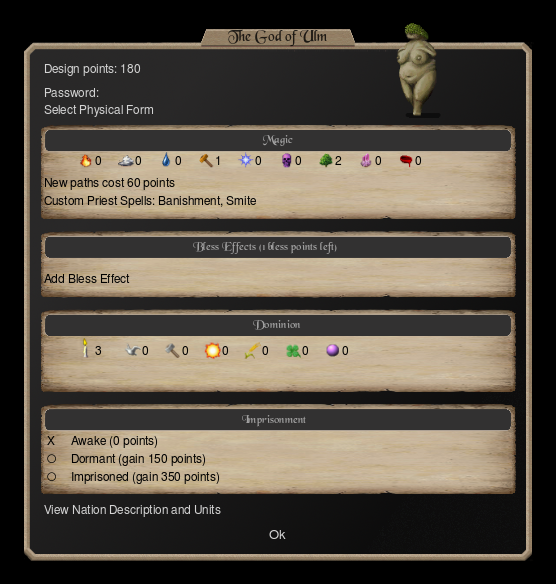
Before the game starts, each human player designs a pretenderpretender · The god you design before the first turn from a limited budget of points, covering its body, magic paths, dominion, scales and how soon it arrives. Full article , the god who leads their nationnation · The people your god leads: their troops, commanders, mages, sacred units, magic paths and history. Each nation is a different game. Full article . This is the one screen where you spend points instead of gold, and it shapes everything after it. The screen opens with a body already chosen, so you can accept it as it stands and start playing. The game will point out that you left points unspent, which is fair. Most players spend longer here than on any other screen, and most of them change their minds after the first game.
You can save a finished pretender and load it into another game later, so a design you like is not lost. The manual gives the keys as Ctrl-S and Ctrl-L on the design screen.
The design budget
A pretender is built from design pointsdesign points · The budget for building a pretender: 450, less the cost of its body. Dormant and imprisoned pretenders get extra. Full article : 450 in the normal case, less the cost of the god’s body. You spend them in a few places, and every point spent in one place is a point the others do not get:
- the physical formphysical form · The body your pretender takes. Every nation offers its own list, and the form's cost comes out of your design points. Full article (the body);
- magic pathsmagic path · One kind of magic: Fire, Air, Water, Earth, Astral, Death, Nature, Glamour or Blood, plus Holy for priests. Skill in a path decides the spells a caster can use. Full article , which also decide the bless effectsbless effect · A bonus bought with bless points when you design your pretender and given to every blessed unit. Which ones you can buy depends on your paths. Full article your sacred troops can have;
- dominion strengthdominion strength · How strongly your god's belief spreads, from 1 to 10 candles. Each candle above the god's base costs design points. Full article ;
- the scalesscales · The dials chosen with your pretender, such as order against turmoil or luck against misfortune. They shape the whole empire slowly but permanently. Full article , which tilt what your dominion does to a province;
- the awakeningawakening · How soon your pretender appears: awake from the start, dormant for about a year, or imprisoned for years. Waiting gives you more design points. Full article , which trades a later arrival for more points.
The sections below take them in turn. The general advice is the one the screen teaches by itself: a god that does everything is thin everywhere, so pick what it is for. A fighter needs a body and little else. A mage-god needs paths. A god meant to carry a bless-based army needs the right paths and a strong dominion.
Physical form
The body your god walks around in. Each nation has its own list, from titans and liches to monoliths that cannot move at all, and the body’s cost comes straight out of your 450 points. Some forms are fighters, some are mages, and some are mostly a very expensive statue. The body also fixes the paths your god starts with and the dominion strength it starts at, which you can then raise.
The pretender units are listed on the pretenders table, and each unit page shows its nations. Your nation’s page says which ones it offers.
Magic paths
A magic pathmagic path · One kind of magic: Fire, Air, Water, Earth, Astral, Death, Nature, Glamour or Blood, plus Holy for priests. Skill in a path decides the spells a caster can use. Full article is one kind of magic. The pretender screen shows nine of them as a row of icons: Fire, Air, Water, Earth, Astral, Death, Nature, Glamour and Blood. A tenth, Holy, belongs to priests. Each has a page on the wiki: Fire, Air, Water, Earth, Astral, Death, Nature, Glamour, Blood and Holy.
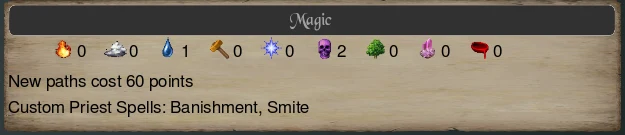
Skill in a path does three jobs at once. It sets what your god can cast, it changes what your priests can do, and it decides which bless effects you can buy.
Each level costs more than the one before. In the manual’s table the first level you add to a path costs 8 points, the second 16, the third 24, and so on, rising by 8 each time to 80 for the tenth. The costs add up: raising a path from one to four costs 72 points. The count is of levels you add, not of the total, so skill that the body already has is free. The screen also shows its own price for opening a path you have no skill in at all; the example in the picture says new paths cost 60 points.
A few ideas to carry into the design screen:
- Depth costs more each level, and spreading thinly over many paths is a well-known way to end up good at none.
- Look at your nation. Its mages have their own paths, and you will be recruiting them all game. The nations overview lists each nation’s paths.
- Spells are listed with the path and the school that make them available on the spells table. Magic basics in step five explains how paths and research fit together.
Blessings and sacred troops
Sacredsacred · Sacred troops are a special class that needs holy points to recruit. They receive your god's blessing when they fight in a province where your dominion is strong. Full article units are the soldiers of a nation that can receive a blessing. They tend to be hired in one place only, the capital, which holds a magic site that allows it, and whoever captures that province cannot hire them. The blessingblessing · A set of bonuses granted to your sacred units when they fight where your dominion is strong. Your pretender's magic paths decide which bonuses it gives. Full article itself is the simplest holy spell in the game, so any priest knows it, yet it can be cast only once a fight has started. Three things come with it:
- one point of moralemorale · A unit's nerve. Fear, losses and a fallen commander test it, and a unit that fails can break and flee. Higher morale holds the line longer; blessings, items and good leaders can raise it. Full article ;
- every bless effect you gave your pretender when you designed it;
- every bless effect of any Throne of Ascension your nation has claimed.
Bless effects are what the design screen sells with bless pointsbless effect · A bonus bought with bless points when you design your pretender and given to every blessed unit. Which ones you can buy depends on your paths. Full article . You earn about one bless point for each level above the first in a path, so a god with Air 2, Death 4 and Nature 6 gets 1 + 3 + 5 = 9 points. An effect costs the skill levels that unlock it: one that needs Astral 3 and Fire 1 costs four points. The scales can add a further requirement for an effect, but they never change its cost. Some effects are always on, such as larger size or not aging; some work only while the pretender itself is awake and alive.
The manual’s own example makes it concrete. A god with Fire 4 and Astral 4 earns six points. Facing an enemy that fields the dead, the player spends four on an effect that gives blessed weapons a solar edge, then the last two on extra magic resistance (MR). Every blessed unit now has both, plus the morale point that all blessed units share.

Pretenders and disciples are blessed automatically while they stand in their own dominion, and cannot be blessed outside it. Sacred units fighting beside their pretender are blessed automatically too, if the battle is in friendly dominion. Which sacred units are worth the trouble, and why a good blessing on the right unit is a whole strategy, is in the strategy article, which also explains the bless rushbless rush · An early strategy of flooding the map with blessed sacred troops to overwhelm opponents before they are ready. Full article . The sacred ability has its own page at Sacred.
Dominion strength
Dominiondominion · The spread of your god's faith. It is not the same as who owns the land, and it matters in battle, in unrest and in how strong your god and its sacred troops are. Full article is how far your god’s belief reaches, and dominion strengthdominion strength · How strongly your god's belief spreads, from 1 to 10 candles. Each candle above the god's base costs design points. Full article is how strongly. It is shown as candles, from one to ten, and every pretender starts with at least one. Each candle above your god’s base costs more than the last: 7 points for the first, 14 for the second, 21 for the third, and so on up to 63. A pretender who starts at three candles pays 7 points to reach four and 14 more to reach five.
What the strength does:
- It decides how likely your dominion is to take hold and spread. Each templetemple · A building that spreads your dominion and lets your priests preach and bless in that province. Full article has a chance of raising your dominion every turn, which is 50 per cent plus 5 per cent for each point of your maximum dominion.
- It caps the dominion you can have in any province. That cap is your god’s starting strength plus one for each block of temples you have built, so temples let you grow past the starting number.
- A pretender, and a prophet, is stronger in friendly dominion: for each candle of friendly dominion where it stands, it gains one point of strengthstrength · Added to the damage of a melee weapon on every hit, so a strong unit hurts more with the same weapon. Full article , half a point of magic resistancemagic resistance · A unit's defence against spells that can be resisted. The target adds a DRN to it, the caster adds one to its penetration, and the caster wins a tie. Full article and ten per cent more hit pointshit points · How much damage a unit can take before it dies. Damage that gets past its protection comes off hit points, and a unit at zero is dead. Big creatures usually have many more than ordinary soldiers. Full article . In enemy dominion it loses the same amounts.
Dominion spreads outward from four places: your pretender, your capital, your temples and a prophet. A priest can also preach in a province to push your dominion up. A province’s dominion is not who owns it: you can hold a province whose people still follow someone else, and the strategy article’s second map is exactly that.
Scales
The scalesscales · The dials chosen with your pretender, such as order against turmoil or luck against misfortune. They shape the whole empire slowly but permanently. Full article are the part of the design that new players tend to skip, and then regret. They are six dials, each with a good side and a bad side, and they shape every province under your dominion, a little more each turn.
Each click of a scale towards its good side costs 40 points. Each click towards its bad side gives you 40 points back, which is why they are called scales: you can tip one down to pay for another. Most can only be tipped about two steps either way. Some pretenders are attuned to a scale, and can push it one step further than normal. A province’s own scales move more slowly than its dominion does, so a province needs several turns of strong dominion before its scales reach what you set, and a weak dominion never gets there.
What each scale does, per step, from the manual’s table:
- Order against turmoil. Order raises income by 3 per cent and resources by 2 per cent, raises recruitment by 10 per cent, helps against unrest and brings 2 per cent fewer random events. Turmoil does the reverse.
- Productivity against sloth. Productivity raises income by 3 per cent and resources by 15 per cent. Sloth lowers both by the same amounts.
- Heat against cold. Neither side is good or bad. Each step away from the temperature a people likes cuts tax income by 5 per cent and supplies by 10 per cent, and some abilities, such as resistance to cold, depend on it. Some nations prefer a particular setting, and the design screen starts there.
- Growth against death. Growth raises population growth by 0.2 per cent a month, supplies by 10 per cent and income by 1 per cent. Death lowers all three by the same amounts.
- Luck against misfortune. Both make random events more common, by 5 per cent. Luck makes the event more likely to be a good one, by 10 per cent; misfortune makes it less likely by 10 per cent. The manual’s table calls luck Fortune.
- Magic against drain. Magic makes spells harder to resist, since every unit in the province loses half a point of magic resistance for each step, cuts the fatigue of casting by 10 per cent, and gives your mages one more research point, with 50 more points to start with. Drain does the reverse.
Two warnings from the manual. Settings of four or more steps usually come with unwanted side effects; the strategy article puts scales among the choices that shape a whole empire slowly but permanently. And a nation’s own scales and its pretender’s can cancel one another, but they cannot stack above one extra step.

Awakening
The awakeningawakening · How soon your pretender appears: awake from the start, dormant for about a year, or imprisoned for years. Waiting gives you more design points. Full article sets when your god actually arrives:
- Awake. Your god starts the game on the map. You have the full 450 points less the body.
- Dormant. Your god arrives about a year into the game, ten to thirteen turns. You get 150 more points.
- Imprisoned. Your god arrives years later, twenty-eight to forty-two turns by the manual’s count. You get 350 more points.
The wait is not exact, and you may wait a little longer or less than another nation in the same game. A god that arrives later buys a bigger body or more magic, at the price of an empire that must run itself meanwhile.
A name is the last choice. If you leave it blank, the game picks one that suits the nation.
When your god dies
A pretender that dies is not gone for good, but it comes back weaker. Each death costs one level in one magic path, or if that does not happen, one point of dominion strength. The chance of losing a magic level is 50 per cent plus 10 per cent for every level of Nature the god had, and a god can never drop below dominion strength one. Bless effects do not change. Nature is the path most likely to be lost, and Death the least, and there is a small chance of gaining Death, Astral or Blood skill instead.
Your priests bring the god back with the Call GodCall God · The order that brings back a dead pretender. Each priest level assigned adds a point, and about fifty points return the god. Full article order. Each level of each priest you assign puts one point in a pool, and when it holds roughly fifty, the god walks back into its home province. Assign four priests whose levels add up to five, and the pool grows by five a turn, so the wait is about ten turns. A few nations have a god that can be called back without losing anything.
Next, step three takes you into the battles your god and its army will fight.
Terms on this page
Generated from the terms used above. This block is what prints.
- pretender
- The god you design before the first turn from a limited budget of points, covering its body, magic paths, dominion, scales and how soon it arrives. · Full article · back to text
- nation
- The people your god leads: their troops, commanders, mages, sacred units, magic paths and history. Each nation is a different game. · Full article · back to text
- design points
- The budget for building a pretender: 450, less the cost of its body. Dormant and imprisoned pretenders get extra. · Full article · back to text
- physical form
- The body your pretender takes. Every nation offers its own list, and the form's cost comes out of your design points. · Full article · back to text
- magic path
- One kind of magic: Fire, Air, Water, Earth, Astral, Death, Nature, Glamour or Blood, plus Holy for priests. Skill in a path decides the spells a caster can use. · Full article · back to text
- bless effect
- A bonus bought with bless points when you design your pretender and given to every blessed unit. Which ones you can buy depends on your paths. · Full article · back to text
- dominion strength
- How strongly your god's belief spreads, from 1 to 10 candles. Each candle above the god's base costs design points. · Full article · back to text
- scales
- The dials chosen with your pretender, such as order against turmoil or luck against misfortune. They shape the whole empire slowly but permanently. · Full article · back to text
- awakening
- How soon your pretender appears: awake from the start, dormant for about a year, or imprisoned for years. Waiting gives you more design points. · Full article · back to text
- sacred
- Sacred troops are a special class that needs holy points to recruit. They receive your god's blessing when they fight in a province where your dominion is strong. · Full article · back to text
- blessing
- A set of bonuses granted to your sacred units when they fight where your dominion is strong. Your pretender's magic paths decide which bonuses it gives. · Full article · back to text
- morale
- A unit's nerve. Fear, losses and a fallen commander test it, and a unit that fails can break and flee. Higher morale holds the line longer; blessings, items and good leaders can raise it. · Full article · back to text
- bless rush
- An early strategy of flooding the map with blessed sacred troops to overwhelm opponents before they are ready. · Full article · back to text
- dominion
- The spread of your god's faith. It is not the same as who owns the land, and it matters in battle, in unrest and in how strong your god and its sacred troops are. · Full article · back to text
- temple
- A building that spreads your dominion and lets your priests preach and bless in that province. · Full article · back to text
- strength
- Added to the damage of a melee weapon on every hit, so a strong unit hurts more with the same weapon. · Full article · back to text
- magic resistance
- A unit's defence against spells that can be resisted. The target adds a DRN to it, the caster adds one to its penetration, and the caster wins a tie. · Full article · back to text
- hit points
- How much damage a unit can take before it dies. Damage that gets past its protection comes off hit points, and a unit at zero is dead. Big creatures usually have many more than ordinary soldiers. · Full article · back to text
- Call God
- The order that brings back a dead pretender. Each priest level assigned adds a point, and about fifty points return the god. · Full article · back to text
Not sure this is your kind of game? That's a reasonable conclusion — here is what it is and isn't.